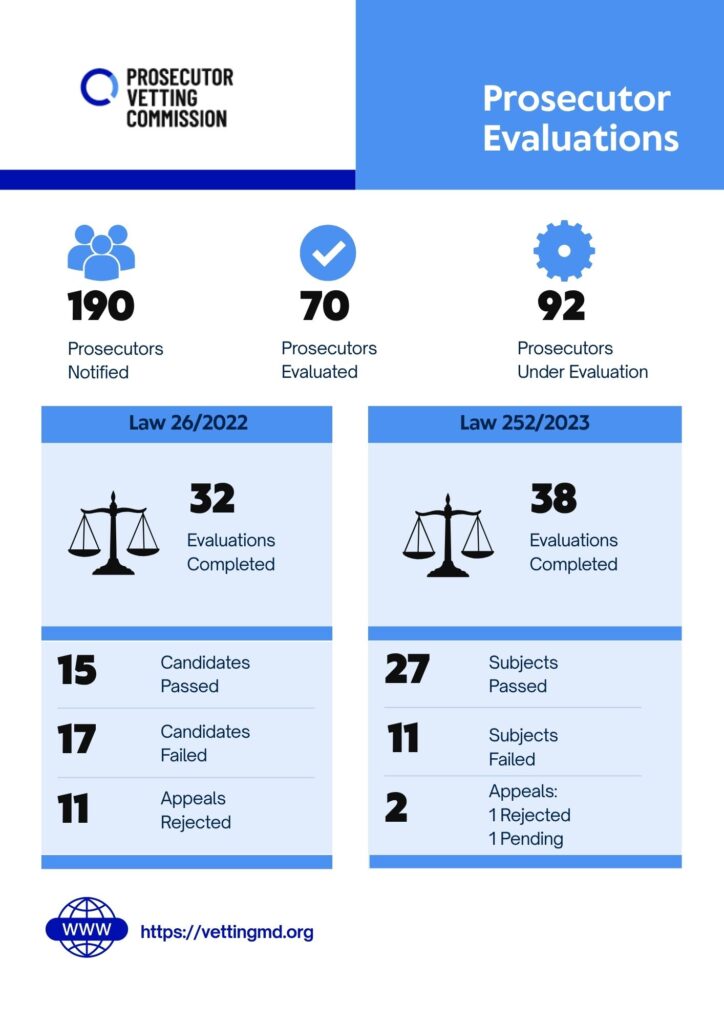
As of June 3, 2026, the Prosecutor Vetting Commission has completed the ethical and financial integrity evaluation process for 70 of the 190 subjects and candidates notified under Laws No. 252/2023 and No. 26/2022. Of those evaluated, 42 passed and 28 failed.
Evaluations Under Law 252 (Evaluation of In-Service Prosecutors)
Under Law No. 252/2023, the Commission has issued 38 evaluation reports and three decisions terminating proceedings in cases where subjects had already passed or failed evaluations under other applicable laws. Overall, the Commission recommended that 27 prosecutors pass the external evaluation, while 11 were recommended to fail.
Evaluations Under Law 26 (Evaluations of Candidates for Specialized Boards)
Under Law No. 26/2022, the Commission has issued 32 evaluation decisions. Fifteen candidates met the ethical and financial integrity criteria and passed the evaluation, while 17 did not meet the criteria and failed.
Appealed Evaluations
Of the 17 failed evaluations under Law No. 26/2022, 11 were appealed before the Supreme Court of Justice (SCJ). All appeals against the Commission were dismissed. Of the 11 failed evaluations under Law No. 252/2023, two were appealed before SCJ. One appeal was dismissed, while one case remains pending.
Status of the Evaluation by Component
APO Prosecutors
A total of 33 prosecutors from the Anti-Corruption Prosecutor’s Office (APO) have been evaluated. Of those, 23 passed and ten failed. The Commission has completed four additional evaluations – and the first two related reports are expected to be issued by June 10, 2026, while the remaining two reports are scheduled for issuance in early July 2026. Currently, 17 APO prosecutors remain under evaluation. Additionally, two APO prosecutors are subject to a Superior Council of Prosecutors-ordered re-evaluation. Separately, ten APO prosecutors resigned within 20 days of notification, and one prosecutor absconded and could not be notified.
GPO Prosecutors
Four prosecutors from the General Prosecutor’s Office (GPO) have been evaluated, three received recommendations to pass the evaluation, while one did not pass. Currently, eight prosecutors are undergoing verification, while two resigned within 20 days of notification. Currently, eight prosecutors from the General Prosecutor’s Office remain under evaluation. In addition, two prosecutors resigned within 20 days of being notified of the initiation of the evaluation procedure.
PCCOCS Prosecutors
One prosecutor from the Prosecutor’s Office for Combating Organized Crime and Special Cases (PCCOCS) has been evaluated and received a recommendation to pass. In addition, 15 prosecutors resigned within 20 days of notification. The evaluation process for the remaining 63 subjects remains underway.
Stages of the External Evaluation Procedure
- Initiation of the evaluation – Notification of the prosecutor and request for initial documentation, including asset declarations, an ethics questionnaire, and a list of close associates.
- Information collection – Gathering information from public and private institutions, information systems, and individuals.
- Analysis and verification of information – Reviewing and verifying the collected information and identifying any inconsistencies or unresolved issues.
- Clarifications and exchange of information – Requesting explanations and additional documents from the subject, including multiple rounds of written questions and answers where necessary.
- Notification of concerns and preparation for the hearing – Providing written notice of unresolved concerns and remaining questions (hearing notification), as well as access to the case file.
- Public hearing – Presentation of explanations and evidence by the subject, along with additional questions from the evaluation panel aimed at clarifying outstanding concerns. Hearings are public, except where otherwise provided by law, and are recorded.
- Evaluation report – Drafting and approval of the evaluation report containing the recommendation to pass or fail the evaluation, followed by its submission to the SCP and the evaluated subject.